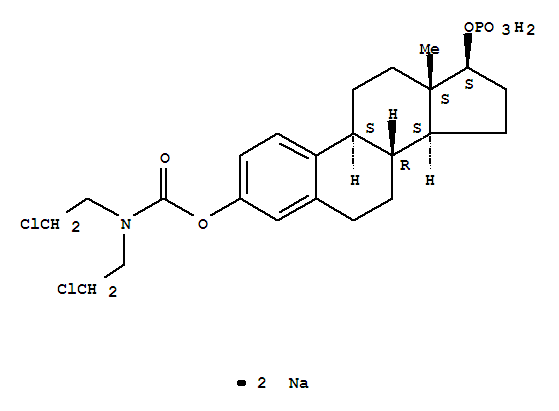
(17-beta)-Estra-1,3,5(10)-triene-3,17-diol 3-(bis(2-chloroethyl)carbamate) 17-(dihydrogenphosphate) disodium salt
- Name: (17-beta)-Estra-1,3,5(10)-triene-3,17-diol 3-(bis(2-chloroethyl)carbamate) 17-(dihydrogenphosphate) disodium salt
- CAS: 52205-73-9
- Purity: 99%
Details
Manufacturer Supply Best Quality (17-beta)-Estra-1,3,5(10)-triene-3,17-diol 3-(bis(2-chloroethyl)carbamate) 17-(dihydrogenphosphate) disodium salt 52205-73-9 with Efficient Transportation
- Molecular Formula: C23H30Cl2NNa2O6P
- Molecular Weight: 566.41
- Vapor Pressure: 2.21E-18mmHg at 25°C
- Boiling Point: 661.2 °C at 760 mmHg
- Flash Point: 353.7 °C
- PSA: 111.77000
- Density: 1.253 g/cm3
- LogP: 6.17540
(17-beta)-Estra-1,3,5(10)-triene-3,17-diol 3-(bis(2-chloroethyl)carbamate) 17-(dihydrogenphosphate) disodium salt(Cas 52205-73-9) Usage
|
Definition |
ChEBI: An organic sodium salt which is the disodium salt of estramustine phosphate. |
|
Brand name |
Emcyt (Pharmacia & Upjohn). |
|
General Description |
Estramustine as the phosphate is available in 140-mg capsulesfor the treatment of prostate cancer. Although originallydesigned as an alkylating agent, it has been shown tobe devoid of alkylating activity and functions as an inhibitorof microtubule function by binding to microtubule associate proteins (MAPs) and also binds to tubulin at a site that isdistinct from that of the vinca alkaloids but thought to partiallyoverlap with that of pacilataxel.The major mechanismby which cells become resistant to the agent involvesincreased efflux, although this is not mediated by Pgp as isthe case with other microtubule inhibitors such as the taxanesand vinca alkaloids. Therefore, the agent does not showcross-resistance with these agents. As an inhibitor of microtubules,it is cell cycle specific acting in the M phase. Theagent is well absorbed upon oral administration with hydrolysisof the water solubilizing phosphate beginning to occurin the GI tract. Metabolism involves the formation of theactive estromustine, which arises from oxidation of the C17alcohol to give the ketone. Additional inactive metabolitesresult from carbamate hydrolysis to give estradiol and estrone.The parent and metabolites are primarily eliminatedin the feces with a terminal elimination half-life of 20 hours.The adverse effects of the agent are nausea and vomiting,which is generally mild but the severity may increase uponprolonged administration. Gynecomastia also commonlyoccurs, and diarrhea may also be seen. Less commonly seeneffects include myelosuppression, skin rash, and cardiovascularabnormalities including CHF. |
InChI:InChI=1/C23H32Cl2NO6P.2Na/c1-23-9-8-18-17-5-3-16(31-22(27)26(12-10-24)13-11-25)14-15(17)2-4-19(18)20(23)6-7-21(23)32-33(28,29)30;;/h3,5,14,18-21H,2,4,6-13H2,1H3,(H2,28,29,30);;/q;2*+1/p-2/t18-,19-,20+,21+,23+;;/m1../s1
Related Products
-
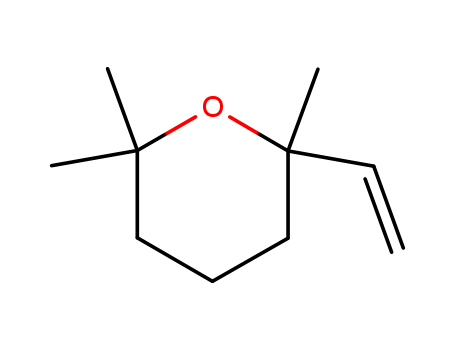 LIMETOL
CAS:7392-19-0
-
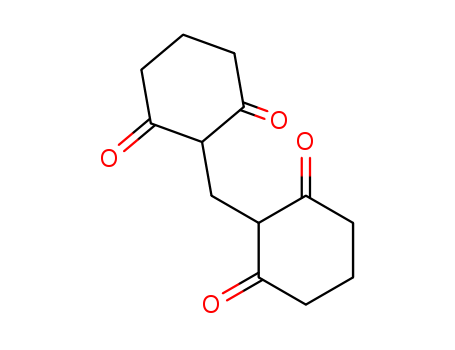 2,2'-METHYLENEBIS(1,3-CYCLOHEXANEDIONE)
CAS:54135-60-3
-
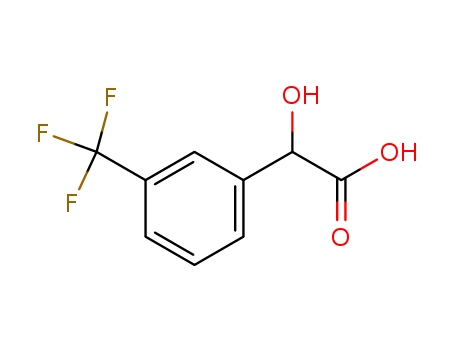 3-(TRIFLUOROMETHYL)MANDELIC ACID
CAS:349-10-0